
Reflective practice is a simple, time-efficient and evidence-based way to enhance your professional performance and improve your wellbeing.
We maximise what we learn from an experience when we step back and actively reflect on it. This is because the act of purposeful reflection helps us develop the skill of metacognition (thinking about thinking), improves our ability to self-assess, and promotes resilience and innovative thinking.
You already reflect on your day-to-day experiences as part of your work, but reflective practice is a structured approach to help you process what has happened and improve future performance.
It encourages:
- self-awareness: being conscious of your actions, decisions, feelings and thoughts, and the skills, knowledge, values, attitudes, and beliefs that may influence them
- critical analysis: evaluating what went well in a specific situation or experience, what did not, and why
- processing and learning: taking the time to understand and learn from difficult experiences, identify when further learning is needed, and consider how you might apply your new insights or skills to future challenges.
Reflective practice is widely used in other professions, and it is increasingly taught in legal education. It is beneficial regardless of how advanced you are in your career.
The ability to reflect and respond effectively is a specific capability in our Early Career Lawyer Capability Framework [link].
Reflective Practice Template
To support lawyers with their reflective practice, we have developed a Reflective Practice Template.
How reflective practice works
Reflective practice is easy to do and can be achieved in as little as 5-10 minutes, but you can also delve deeper into your experiences over a longer period.
There are several ways to approach reflective practice, but Gibbs’ Reflective Cycle describes this simple and straightforward six-step process:
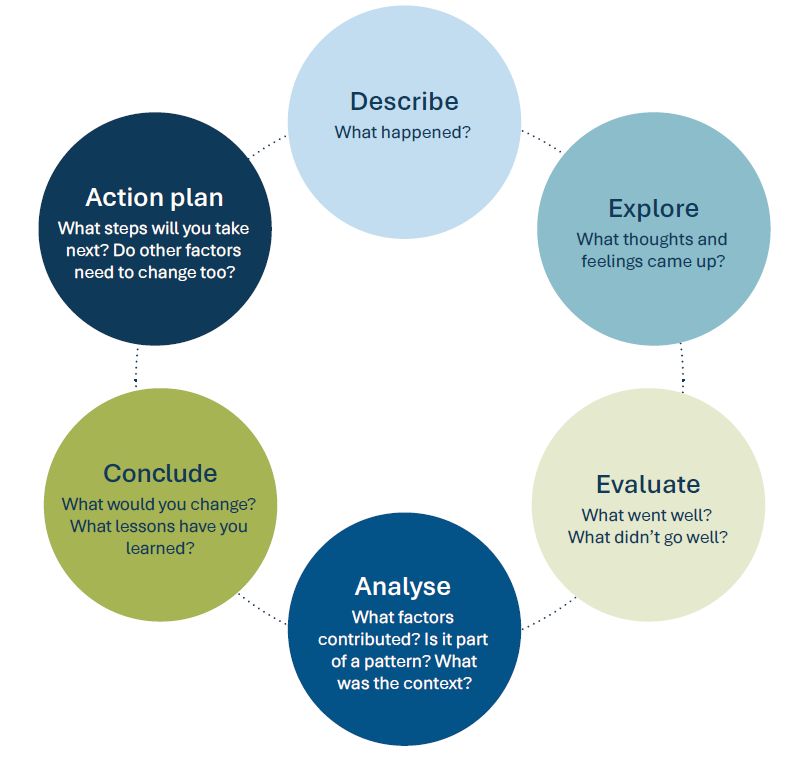
When to do reflective practice
You can reflect on any situation, experience or event that you think would be useful to explore and learn from. Examples might be:
- your professional performance (e.g. on a particular matter or a complex court appearance)
- challenging interactions with clients or colleagues
- a professional development activity
- uncertainty in your work
- barriers to progress.
Reflective practice can also be used before or during an experience. Doing this can help you to prepare for, adapt to, or mitigate issues.
Benefits of reflective practice for lawyers
Many professionals working in complex environments – including doctors, teachers and social workers – find reflective practice to be a useful professional development tool. It also has clear benefits for lawyers, who are very well-placed to engage in reflective practice, given it involves deep thinking, analysis and evaluation of situations, events or experiences.
Some of the benefits of reflective practice for lawyers include:
Reflective practice supports your professional performance in many ways including:
- critically assessing the quality of your work
- identifying and harnessing your strengths and weaknesses
- planning professional development activities for areas needing improvement.
Reflecting on and learning from your experiences helps you to develop and practice adaptability and flexibility, which supports you to be a more creative, innovative and resilient legal professional. This will enable you to better manage and respond to the uncertainties inherent in legal practice.
Repetition without reflection tends to produce automatic responses which increase the risk of developing bad habits. Engaging in reflective practice encourages you to challenge your assumptions and expectations, which not only makes you a better lawyer but also contributes to motivation and job satisfaction.
Reflective practice helps foster better professional judgement and promotes client-focused legal service delivery by encouraging reflection on your own (and your team’s) capabilities, efficiency, decisions and actions. It supports better communication with clients and others, as you improve your understanding of others’ emotions and motivations and apply your learnings from previous interactions to future encounters.
Critically reflecting on the service you provided also supports you to take a more holistic approach to problem-solving, which can assist you to come up with new or more responsive strategies to meet client needs in future.
Reflection helps you recognise and process challenging or complex experiences and situations. It builds your self-awareness, including of your own values, strengths and weaknesses, and your emotional intelligence, which is your ability to understand and manage your own emotions and your sensitivity to others.
Greater self-awareness and emotional intelligence can help you cope with circumstances that might be beyond your control and better protects you against the risks of workplace stress, burnout or vicarious trauma.
Engaging in reflective practice enables you to consider your experiences through multiple perspectives, including through the lens of your professional and ethical obligations. In this way, it fosters your ability to analyse and understand a situation from an ethical and professional perspective.
Educational neuroscientists emphasise that intentional engagement in reflective practice is key to ‘cementing’ learning and enhancing retention, recall, and application of the new skills/knowledge.
It supports you to become an effective, self-directed learner and to get the most out of your mandatory CPD activities. Reflective practice fosters reflection on and self-assessment of your existing knowledge, skills and attitudes, and areas for improvement, supporting you to master your area of practice.
After undertaking a CPD activity, use reflective practice to think about what you learned and how you might apply it to your practice.
Reflective practice for early career lawyers
While legal education emphasises technical knowledge and legal reasoning, early career lawyers also need to develop judgement, communication skills, emotional intelligence, and ethical sensitivity. Reflective practice helps you to build these skills, bridging the gap between legal education and the realities of professional practice.
Making reflective practice a habit will help you process events, situations and experiences that occur during what is a period of intense professional growth. Structured reflections can also prepare you to engage in constructive discussions about your performance with others, including your supervisor.
The ability to reflect on your actions and respond accordingly is a specific capability in our Early Career Lawyer Capability Framework which sets out the capabilities early career lawyers should develop during their supervised legal practice period.