
Artificial Intelligence (AI) tools have the potential to improve efficiency, reduce administrative burden and enhance access to legal services. As these technologies become more common in legal practice, we want to support lawyers to understand both the opportunities they present and the risks that must be managed.
Our Risk Outlook 2026 highlights how the use of AI tools creates risks that must be considered and managed to comply with professional obligations. In the 2025 Lawyer Census, 70% of Victorian lawyers said they would benefit from more guidance on AI.
That's why we've created new resources to support lawyers to use AI safely, responsibly and in line with their professional obligations.
Data shows AI use is growing
A new report by the Legal Services Research Centre found 55% of Victorian lawyers are now using AI tools in their legal practice, up from 37% in 2025. Among lawyers using AI, 78% said their use for legal work had increased over the past year.
Who is using AI has also changed. AI use is no longer concentrated amongst younger lawyers, with lawyers at every level of seniority reporting using AI.
Corporate lawyers (77%) and those working for non-legal employers (79%) have the highest rates of adoption, while use is less common amongst barristers (38%), government legal practitioners (31%) and community legal centre lawyers (25%). Organisations with 200+ employees are adopting AI at a faster rate than smaller practices.
Law practices need to decide whether and how to adopt AI
As the regulator of the Victorian legal profession, we encourage all lawyers to build their understanding of AI.
Many law practices are already using these technologies, and AI is being built into the systems, software and devices used across legal practice. Clients are also increasingly arriving with AI-generated information, some of which is inaccurate and requires correction.
Understanding how AI works, where it can help, and where caution is needed is now an important part of competent legal practice.
Law practices can strengthen the benefits of AI by considering broader changes to workflows, business models and pricing.
New AI resources to support your work
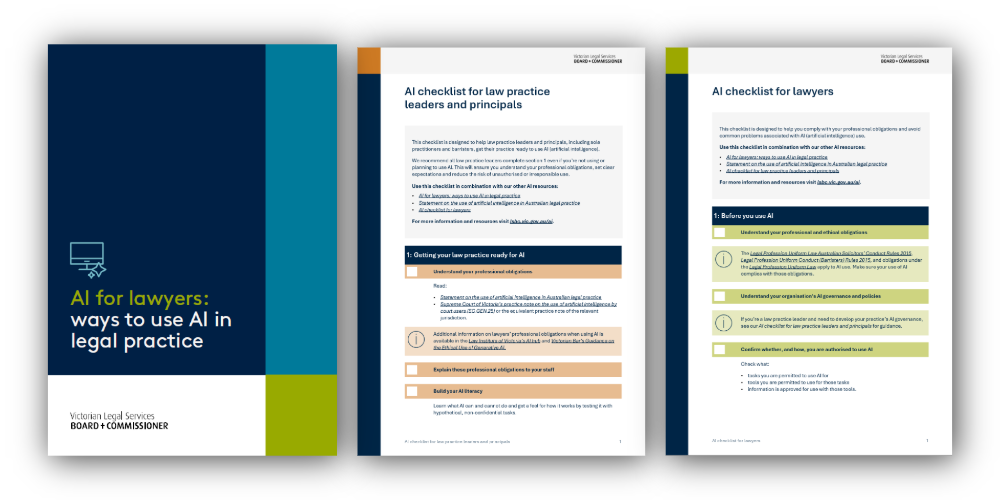
We’ve published new resources to help lawyers and law practices make informed decisions about adopting AI and understand what to consider when using AI in legal practice.
The new resources will benefit all Victorian lawyers but are particularly valuable for small practices and sole practitioners who may not have access to specialist AI and technology expertise.
- AI for lawyers: ways to use AI in legal practice
outlines how AI can be used in everyday legal work, with tips for ethical and responsible use. - AI checklist for law practice leaders and principals
guides law practice leaders and principals on how to introduce and manage AI in their practice. - AI checklist for lawyers
helps all lawyers to use AI responsibly and in line with their professional obligations.
As part of the development of these resources, we consulted with AI experts, the Law Library of Victoria, Law Institute of Victoria, Victorian Bar, Legal Practitioners’ Liability Committee, as well as individual lawyers.
AI and your professional obligations
While AI offers a significant opportunity to help transform legal service delivery, it also creates risks that lawyers and law practices need to manage.
We’ve been receiving reports of inappropriate uses of AI in legal practice including:
- documents being submitted to the courts that haven’t been checked and contain hallucinated cases
- senior lawyers not checking the AI-generated work of junior lawyers
- practices uploading sensitive information into public-facing tools.
Last year, we varied the practising certificate of a lawyer for providing inaccurate AI-generated citations and summaries to the Federal Circuit and Family Court of Australia.
AI doesn’t replace a lawyer’s professional skill and judgement. Lawyers remain responsible for the services they provide and must ensure AI use is consistent with their professional and ethical obligations, including protecting client confidentiality.
Our new AI resources are supported by the existing Statement on the use of artificial intelligence in Australian legal practice. This statement was published in partnership with the Law Society of New South Wales and Legal Practice Board of Western Australia and outlines our expectations of lawyers when they use AI.