
- PDF doc
- 421.4 KB
As judicial officers and tribunal members, we welcome and value information from you if you have concerns about a lawyer or law practice. Your experience and daily interaction with lawyers means you are well placed to identify concerning conduct that we may otherwise be unaware of.
This document explains our authority as the legal regulator in Victoria, concerns that you can raise with us, and how to raise them. It also outlines the steps we may take in addressing your concerns. We encourage you to contact us and welcome any questions about our role or processes.
The Victorian Legal Services Board (Board) and Victorian Legal Services Commissioner (Commissioner) are the independent statutory authorities responsible for the regulation of the Victorian legal profession in accordance with the Legal Profession Uniform Law (Uniform Law), as set out in Schedule 1 to the Legal Profession Uniform Law Application Act 2014 (Vic) (Application Act).
The Board and Commissioner operate as one organisation – the Victorian Legal Services Board and Commissioner (VLSB+C) – but each authority has specific functions under the Application Act. The Commissioner handles complaints about lawyers and law practices.
For more information on our role see about us section of this website.
You are welcome to contact us if you are concerned about any conduct that:
- does not meet professional standards – for example breaches of the solicitor or barrister conduct rules, Uniform Law obligations (such as costs disclosure or trust accounting obligations), or obligations under other laws or rules of court
- is prejudicial to the administration of justice
- is likely to diminish public confidence in the legal profession or the administration of justice
- otherwise brings the profession into disrepute.
Below are examples of the types of issues you may wish to bring to our attention.
Lawyer conduct
Dishonest or disreputable conduct, or acting without integrity
- Failing to comply with court or tribunal orders or undertakings without reasonable excuse
- Acting with disregard for the law or the administration of justice
- Misleading a client about a court or tribunal proceeding allegedly initiated on their behalf, or misleading the client about the progress of their court or tribunal proceeding
- Making statements or submissions that mislead, or are likely to mislead, the court or tribunal
Lack of competence adversely affecting proceedings or client interests
- Failing to properly advise clients about their rights and obligations
- Failing to comply with their overarching obligations as the representative of a litigant
- Grossly overcharging their client or repeatedly not providing appropriate costs disclosure
- Attending proceedings under the influence of drugs or alcohol, or otherwise being unfit to appear
- Mishandling client money — e.g. where it is alleged that money paid into trust is missing or misallocated, or a client indicates they have paid legal fees upfront but received no service
Inappropriate conduct adversely affecting the progress of a matter
- Inappropriate communications with the court or tribunal
- Inappropriate communications with other parties or their representatives
- Abusive or offensive conduct in proceedings (e.g. aggressive questioning of witnesses, threats of physical harm (implied or explicit), or demeaning, intimidating, insulting or profane language
If we receive information or a complaint about a lawyer’s conduct, we will assess it and decide what action, if any, is needed. Depending on the issues raised, this may include opening a Commissioner-initiated complaint, reviewing the lawyer’s suitability to hold a practising certificate, or conducting a compliance audit of the law practice.
Unqualified legal practice
- A non-lawyer engaging in, or making representations they can engage in, legal practice
- A lawyer engaging in legal practice without holding a current Australian practising certificate
- A lay representative (e.g. a McKenzie friend) exceeding the limitations of their role
If there is evidence of unqualified legal practice (ULP), we may investigate and prosecute it as a criminal offence, apply for an injunction to restrain the person from engaging in further ULP, or take another regulatory response such as education or a warning.
Law practice distress or dysfunction
- A lawyer suddenly ceasing to appear before, or communicate with, the court or tribunal without explanation
- The court or tribunal being informed of the death and/or incapacity of a sole principal lawyer
- The court or tribunal becoming aware that a law practice must immediately cease trading (or has ceased trading) due to insolvency or being placed under external administration (e.g. where liquidators or receivers have been appointed)
If you inform us of these matters, we can take steps to protect the interests of clients – including by ordering an external intervention into the law practice or issuing management system directions (following an examination, compliance audit or investigation).
If you have concerns about a lawyer or law practice, there are two ways to bring them to our attention:
1. Make a formal complaint
This is a formal action that triggers legislative processes and you would be recorded as the complainant. For more information see Chapter 5 of the Uniform Law.
2. Provide information
If you don’t want to make a formal complaint, you can still share your concerns with us. We will assess the information and determine whether further action is warranted – for example, opening a Commissioner-initiated complaint. You will not be recorded as a complainant if we decide to take action. If we decide to investigate the matter, information you provide will be shared with the lawyer or law practice.
Information required
The information that helps us assess a concern or complaint will depend on the circumstances. Where available, please include relevant details such as:
- whether you are making a formal complaint under the Uniform Law, or providing information
- your name, role, and jurisdiction
- the lawyer or law practice involved
- details of the alleged conduct (this can be brief and does not need to include conclusions as to misconduct)
- the stage of proceedings (e.g. whether still before the court or tribunal, or finalised)
- details of any restrictions on identifying any person involved
- your contact details, or those of a nominated contact (e.g. your associate)
- any actions that have been taken in response, or other relevant information
- any supporting documents or witness details (e.g. transcripts, recordings, submissions, exhibits, court file).
You can contact us any time during or after proceedings. A member of our team can help you decide whether to raise a concern, or make a complaint, and provide guidance on whether a matter falls within our role. Before contacting us, you may wish to discuss the matter with your Head of Jurisdiction.
We recognise the important role of the court and tribunal in managing its own proceedings and will not typically take any action until proceedings are finalised. If you reasonably consider that a lawyer’s conduct discloses a prima facie case of professional misconduct or unsatisfactory professional conduct, it will generally be appropriate to defer making a complaint until after the litigation has concluded. Information you provide helps us uphold professional standards, protect consumers and support the administration of justice.
The best way to contact us is via email at lsbc_Investigations@lsbc.vic.gov.au.
This email is a dedicated contact point for judicial officers and tribunal members. When sending the email, include in the subject line: [Your title] [Surname] – complaint/concern about lawyer or law practice
If you would prefer to call, you can speak to a member of our team on (03) 9679 8097.
This flowchart sets out the potential outcomes when you provide information or make a complaint.
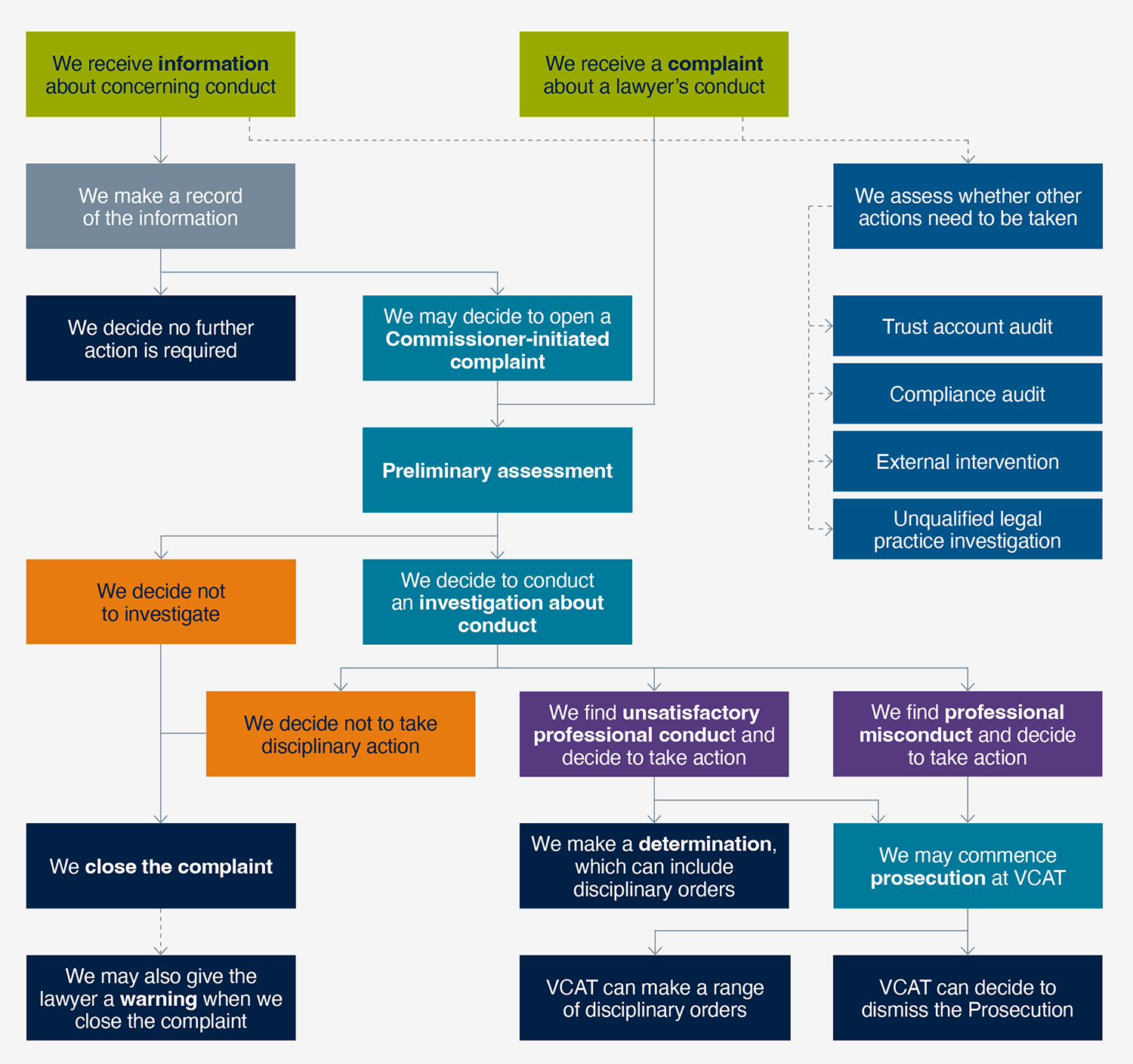
Image description:
A flowchart outlines the possible outcomes when we receive information about a lawyer’s conduct, or a complaint about a lawyer’s conduct is made.
If information about conduct is provided we will record this information and decide whether further action is required. If we decide no further action is required, the process ends. If action is needed, we will open a Commissioner-initiated complaint and conduct a preliminary assessment before deciding whether to investigate the conduct.
If a complaint is submitted we will open a Commissioner-initiated complaint and conduct a preliminary assessment. Based on this we will decide whether to investigate the conduct.
During both of these processes, we may also assess whether other actions are needed, such as a trust account audit, compliance audit, external intervention, or investigation of unqualified legal practice.
If we conduct an investigation, possible outcomes may be:
- We decide not to take disciplinary action and close the complaint. We may issue a warning to the lawyer.
- If unsatisfactory professional conduct is found, we will make a determination, which can include disciplinary orders.
- If professional misconduct is found we may commence prosecution at the Victorian Civil and Administrative Tribunal (VCAT). VCAT can make a range of disciplinary orders or decide to dismiss the prosecution.

Last updated on