


Generative AI continues to change how lawyers work and how they interact with clients. However, evidence of these changes is often anecdotal or speculative. Through our annual Lawyer Census, we collect the empirical data needed to paint a more measured picture of the effect AI is having on the profession.
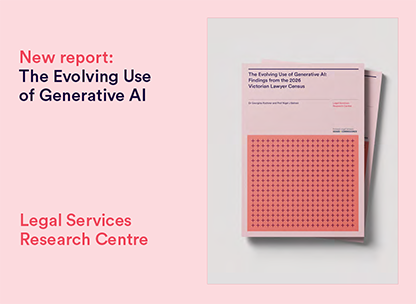
Our new report, The Evolving Use of Generative AI: Findings from the 2026 Victorian Lawyer Census, draws on responses from 2,221 lawyers to examine evolving AI use, and changes to both pricing practice and to the lawyer-client relationship attributed to AI. We thank the legal practitioners who took part.
Evolving use and users of generative AI
Use of generative AI by legal practitioners rose from 37% in 2025 to 55% in 2026. Of those using AI, 78% reported that their use of AI for legal work had increased in the past year.
In 2025 use was more concentrated among younger and early-career lawyers, in 2026 these differences had largely disappeared, at least among those under 60. Disparities remained by organisation and practising certificate type. AI use was higher among corporate lawyers, those working for non-legal employers and those in law firms, than among those working in the legal assistance sector, for government employers, or as barristers.
Off the peg still suits
Reliance on general-purpose AI tools remained heavy (79% of users, comparable to 2025), with only a modest increase in use of legal-specific tools (51% compared to 46% in 2025). Most users (71%) reported that their employer specified the AI tool they may use, though specification bore little relationship to the relative percentages of general purpose and legal specific tools.
For most lawyers, AI is yet to reshape pricing practice
The 2026 Census asked AI users in fee-charging practice whether AI had enabled them to take on work that would previously have been uneconomical, and whether (as a result of AI) they had reduced fees, introduced fixed-fee/capped-fee arrangements or unbundled legal services. Most respondents reported none of these changes.
Just over a quarter of respondents (26%) reported reduced fees for clients as a result of AI, while eighteen per cent reported that AI had enabled them to take on more work that would previously have been uneconomical. Fewer reported the introduction of fixed-fee or capped-fee arrangements (7%) or the unbundling of legal services (3%).
But AI is changing the lawyer-client relationship
Lawyers felt that clients' AI use led to accuracy problems far more often than to better client understanding. They also pointed to changes in how clients approached them; including attempting legal tasks themselves before seeking professional help, questioning or challenging advice on the basis of AI output, and requesting specific strategies or documents identified from AI output.
Such changes were reported more often among respondents who worked at community legal centres, in incorporated legal practices, for non-legal employers and in law firms. Community legal centre lawyers recorded the highest rate of clients arriving with inaccurate or misleading information (59%), and one of the lowest rates of clients arriving with a better understanding of their legal issues (4%).
Almost half of respondents (46%) indicated that clients' use of AI had increased the time and effort needed to deliver services, with only 19% suggesting it had reduced it. In community legal centres, 58% reported an increase and just 4% a reduction.
We are leaving…. for a destination we still don’t know
Lawyers are increasingly on board, but where AI is taking the profession, who stands to benefit, is still unknown. While there is potential, lawyer census findings suggest gains are incomplete and uneven. There is also much more to understand about how tools and use cases interact, and how risks and benefits are distributed – a key consideration for future iterations of the Lawyer Census.
AI uptake is rising, though gaps in use in between practice settings remain. Benefits such as lower fees are concentrated in a narrow part of the market, while the additional work that lawyers attribute to clients’ AI use falls most heavily on the services with the fewest resources and most disadvantaged clients. If equitable access to justice is an aspirational destination, we have barely left the station.
This is only one side of the story. Lawyers may see clients who arrive misinformed, but not the people who used AI to resolve a problem without ever needing a lawyer, or those it steered away from help they needed. The public's perspective will come from our Legal Understanding and Lawyer Use (LULU) survey, which will track how the public use AI to understand and address their legal problems, regardless of legal service use.
Together with the annual Lawyer Census it will continue to map how this evolves, who bears the risks and who can share the benefits, both in lawyers’ working lives and in the justice the system delivers.