


by Nigel Balmer, Legal Services Research Director
We know that there is a lot of law out there. All of us have an evolving range of rights and obligations, with the situations where these rights and obligations may need to be applied or enforced all too commonplace. Yet, we still don’t know as much as we would like about what helps navigate all of this.
My friend Professor Pascoe Pleasence (UCL) and I set out to try to fill this gap many years ago. It is a long road, with a long way yet to go, but we feel like we are making progress. At the heart of this progress has been the concept of legal capability, which we think of as the freedom and ability to navigate and utilise legal frameworks to achieve fair resolution of problems. That sounds like something of a mouthful, but handily Pascoe and I provided a chapter on legal capability for the recent Research Handbook on Civil Justice. It aims to act as a primer, setting out what it is, why it matters and what we might do about it.
And as an aside, there is lots more in the handbook. It brings together 26 chapters from leading international scholars examining civil justice systems across the globe. It is a privilege to publish alongside such esteemed colleagues, old and new.

Legal capability and why you should care
Legal capability includes internal capabilities – people's knowledge, skills, and attributes – and external opportunities – the structure and functioning of legal institutions and services. What matters is the combination of the two. Internal capabilities include things like the extent to which people perceive issues as ‘legal’, understand their rights, see services as accessible, and feel able to access appropriate help, and confidently pursue just outcomes. But whether internal capabilities translates into just outcomes depends as much on how the system is designed and responds as on what people bring. Without both internal capabilities and complementary external opportunities, the possession of legal rights can be largely meaningless.
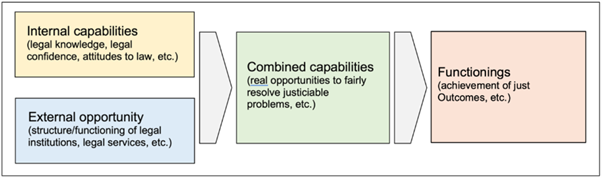
Drawing extensively on our Public Understanding of Law Survey (PULS) research and other work, we see that internal legal capability remains unevenly distributed across society. People often misunderstand their rights, and negative experiences with lawyers or courts erode confidence and trust, creating cycles of disengagement and compounding existing disadvantage. Whether problems are thought of as "legal" varies widely, and can affect whether people are able to access appropriate help.
These capability gaps fall disproportionately on already-disadvantaged groups, though critically, legal capability is not the same as disadvantage. And the primary responsibility for responding to this variation sits with the system, not with individuals. One size does not fit all, and services assuming uniform capability can end up truly fitting few.
The path ahead
Understanding legal capability is not peripheral to access to justice policy, it is fundamental. The chapter explores how we might respond. And things are already happening, including here at the VLSB+C where the importance of legal capability is central to its recent Early Career Lawyer Capability Framework.
Our findings point to the need to balance building internal capabilities with expanding external opportunities. To the value of a visible general advice sector and outreach alongside more traditional legal services, to balancing 'just in case' public legal education with 'just in time' interventions, and to supporting positive client experiences to build confidence and trust.
Finally, for those interested in exploring these issues further, Professor Pleasence and I are finalising a companion piece that builds on this foundation. Drawing on fresh findings from the Legal Services Board's Legal Understanding and Legal Use (LULU) survey, it examines the practical implications for policy and practice in greater depth. If you just can’t wait, I am open to leaking a preview – feel free to get in touch.